Community Wi-Fi Grant Program
The Community Wi-Fi program is a $10 million competitive reimbursement subgrant under the CEN Broadband Infrastructure Program, funded by the ARPA Capital Project Fund and supported by Governor Lamont’s Connecticut’s Plan for the American Rescue Plan of 2021. Designed to aid COVID-19 recovery, the program enhances internet infrastructure for work, education, health, and wellness. By leveraging the CEN infrastructure platform, the program will expand high-quality, secure, 802.11-based wireless internet access through Community Anchor Institutions (CAIs) across Connecticut, with a focus on underserved and economically disadvantaged communities. The program also promotes the adoption of eduroam®, a global platform for secure, authenticated Wi-Fi access, further extending connectivity and support to users across institutions. Any CAI can apply for grant funds to attach to CEN and expand high-quality and secure Wi-Fi in their communities.
Special Discounts for CEN Community Wi-Fi Grant Proposals
Cisco is supporting the Community WiFi Grant Program by offering minimum 60% off list price for Meraki Wi-Fi products, including Cisco Cloud Manager Wireless. All authorized resellers can pass through these savings on hardware and licensing for your Grant applications.

Juniper is supporting the Community Wi-Fi Grant Program by offering minimum 59% off list pricing for all hardware and 30% off list pricing for all licensing for Mist Wi-Fi products (including PoE switches to help power them). All authorized resellers can pass through these savings in support of your Grant applications.
Community Wi-Fi Program Info Session Webinars
Throughout the month of January, we held four Community Wi-Fi Grant Program Info Session Webinars: three for applicants, and one for OEM/Resellers/Integrators. Below you will find a recording of that webinar and the slide deck for you to reference as needed.
Program Objectives
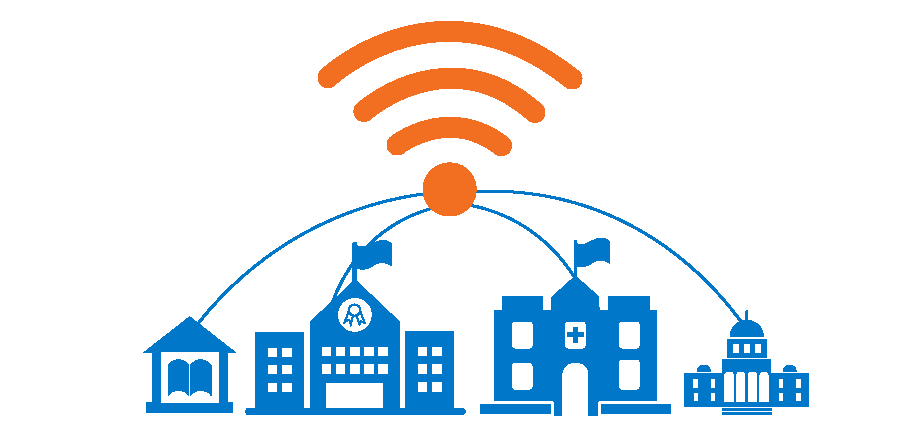
Equity of Access to Internet
Expand high-quality internet access to Connecticut citizens by targeting communities in need and leveraging existing infrastructure.

Partnerships
Encourage partnerships between municipalities, schools, libraries, other community anchor institutions, and private partners.

Transformational Recovery
Directly support recovery from the COVID-19 public health emergency by strengthening and improving the infrastructure necessary for participation in work, education, health and wellness.

Sustainability
Ensure sustainability of solutions by requiring the applicants to commit to the wireless service through the funding period and beyond.
Expanding eduroam
Expanding the reach of eduroam so that every teacher, learner, and education-based staff person and administrator can connect to Wi-Fi safely, securely, and across any institution in the state.
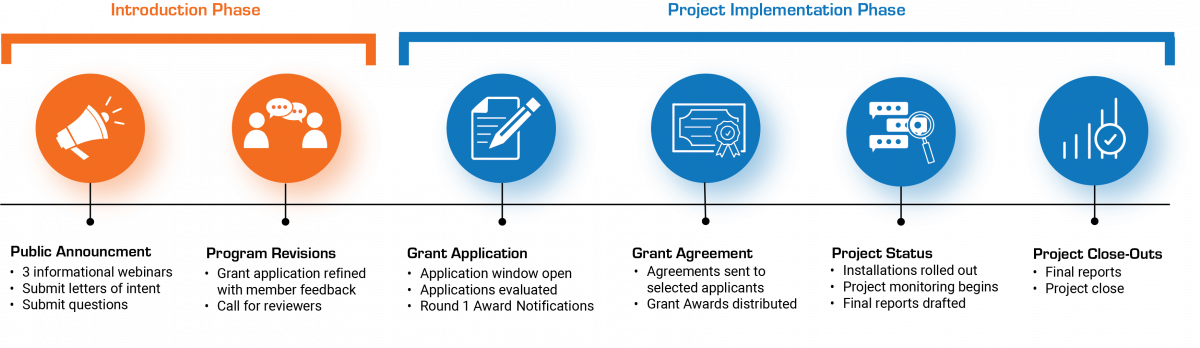
Preliminary Dates
*Dates are subject to change
Program Documents and Application Requirements
Application Intake | Pre-Application Checklist
Appendix A – Application Overview |
Applicant Award | Appendix E – Application Terms & Conditions |
Post-Award Documents | Appendix H – Project Reporting Template
Appendix I – Project Completion Affidavit |
Frequently Asked Questions (FAQs)

Here, you will find answers to common questions about the Community Wi-Fi Grant Program.
This section will be regularly updated to include new questions as they arise. Stay tuned for the latest information!
Applicant and Project Eligibility
Yes. The purpose of the letter of intent was to gauge interest from potential applicants, not a requirement to submit an application during the application window.
Applicants can contact CEN at CENwifigrant@cteducation.net to request assistance as they prepare to apply, and move through the application process.
No, there is no certification or recognition required in order to identify as a CAI. So long as an entity meets the definition of a CAI under the US Code, Title 47, Chapter 16, Section 1702 (a)(2)(E) then it is eligible. The definition is detailed in the Program Guidance document under section 2.1, Eligible Applicants.
Aiming to partner and establish projects across CAIs such as libraries, school districts and universities in a municipal area is a great approach that helps pool resources across different kinds of partners. However, applications can be more ambitious and get creative so long as their proposals demonstrate how they can get it done.
An executive sponsor would be someone at the executive level of your entity or organization who has the authority and influence to champion the project, and ensure its alignment with the organization’s strategic objectives.
Yes, grant funds could be used to help attach to or extend CEN network services to a location and wifi to new areas, so long as the narrative around it demonstrates community need.
Yes, the grant can be used to extend coverage to green spaces so long as the application demonstrates how the project is meeting the needs for an underserved community.
No, matching funds (or giving in-kind contributions) is not a requirement, though it is encouraged and is given preference during the application scoring process. If an agency will be pouring a lot of resources into executing a project, these can be considered in-kind contributions so long as they are very clearly articulated and quantified in the program budget (i.e. anticipated hours required to install equipment).
Yes, per state and federal guidance, work must be performed by licensed and certified personnel. Some are also protected trades for prevailing wage where applicable as required flow down language from federal guidance and state of CT statute.
Yes, these grant dollars are bound to the State of CT and can be used in rural and urban settings so long as the application demonstrates how it will meet the needs of an underserved community.
No, CIPA compliance is not mandatory and is not part of the grant program.
Grant funds can only be used for projects that would expand coverage, and can’t be used on expenses that would be considered operational expenses. If an institution were to upgrade current internet speeds, expenses that go into hardware to make those upgrades possible could be paid for with grant dollars, but not the cost of operating those speeds as regular recurring costs.
Yes, however any projects proposed would need to demonstrate how they are meeting the needs for an underserved community.
Recipients may use CPF funds to pay for certain eligible costs incurred after March 15, 2021, but before the Period of Performance Start Date (“Pre-Award Costs”) subject to certain conditions. Any Pre-Award Costs must be disclosed, explained, and submitted along with corresponding Program Plan materials to be reviewed and approved by Treasury. Recipients can refer to Section 10 of the Grant Agreement and Section I.D.b of the Capital Projects Fund Guidance for additional information about Pre-Award Costs. All funds must be used for costs incurred during the period of performance or for Pre-Award Costs.
Stacking grants or braiding of funds is possible, though in the application you need to be clear and able to articulate what the grant funds are covering, how they are additive, and demonstrate that no dependencies exist between the two. For example, you need to demonstrate each project can stand on their own, if only one is funded.
A lead applicant should declare a partnership and provide a partnership agreement or MOU anytime they intend to work with another entity in order to execute the proposed project. Partnerships can be established for the sole purpose of completing this project so long as it meets the criteria outlined in the Program Guidance under Section 2.1.
The question on the application inquiring about whether a proposed project meets this specific project prioritization criteria offers applicants who may or may not have a formal partnership involved in the application to highlight how they coordinated efforts to streamline and expand the reach of a proposed project within a single project proposal.
No, an applicant could provide a response on the application question that inquires about project prioritization criteria without having a formal partnership declared on their application. However applicants should be able to demonstrate and highlight how their project proposal’s ideation leveraged community partnerships through a coordinated effort to streamline and expand the reach of their proposal within a single application.
Supplant replaces funding that has already been appropriated for work related to a grant project. If a CAI has funds budgeted for extending wi-fi coverage, the CAI cannot replace those funds with the grant funds. That is supplanting. Adding the grant program funds to already appropriated funds is considered supplementing and is permitted.
This grant requires applicants to complete all project implementation activities by June 30, 2026, and asks that the systems installed have payors involved who can cover all operational expenses for a period of at least five years as part of ownership and management. For this reason, any initial licensing for equipment should cover that 5-year period. Check warranties on new equipment to confirm where and when equipment failure is covered.
Specifically regarding eduroam, there is no fee since CEN covers that as the regional support organization. This means anyone who does implement eduroam would benefit from its seamless user experience and minimal support, while also receiving better reporting that shows who guests/users are and their home institutions.
Internal staffing costs can be quantified either way, as a direct expense or as an ‘in-kind’ matching contribution, or alternatively by subcontracting out labor so it becomes a direct reimbursable expense. The in-kind contribution option would receive some preference during the application review process. Regardless of how things are set up, operations would need to remain in compliance with the same federal uniform guidance required for any other grant program.
Applicants must upload a statement or attestation confirming their financial viability and capability. This statement should provide assurance of the Applicant’s ability to manage and sustain the financial aspects of the proposed project. To ascertain the proposed project’s financial viability and sustainability, applicants must submit a statement or attestation. This document should explicitly affirm the applicant’s financial capacity to manage and maintain the project’s fiscal obligations throughout its duration.
The statement should demonstrate the applicant’s ability to secure and allocate sufficient funds to cover all project-related expenses, including but not limited to non-eligible expenses. Additionally, the statement should ideally highlight the applicant’s financial management expertise, past performance in handling similar projects, and risk mitigation strategies to ensure the project’s financial success.
Technical and eduroam Specific
Yes, any SSID, including eduroam, is going to flow through your wi-fi and campus infrastructure.
Posting signage is encouraged but is not required.
No, anyone can be a host site for eduroam, they do not need to be a school. Eduroam comes in two flavors, service provider or ‘SP’ where you broadcast the SSID as an eduroam friendly site with no local identiy store (accounts) tie in of your own, OR, eduroam Identiry Provder or ‘IdP’ where the local identity store is tied into the federation has a RADIUS server and operates its own proxy realm.
No, access needs to be available to non-eduroam credentialed users through another SSID on the wi-fi network. Deploying eduroam provides a mechanism for those individuals who already have eduroam credentials to easily authenticate and attach to a secure network.
No, there is no content filter included with eduroam. The host location is able and responsible to manage any CIPA content filters they may need in place. You can filter if you want / need to on your network. Eduroam is about access, authentication, and encryption over the air. Firewalling, filtering, and access control are up to the local network operator to implement and maintain.
Yes, those who include eduroam will still have the ability to impose filtering. If you need filtering on devices that are not on your network, you may need to implement an agent-based filter. Agent or machine based filters for endpoints are not grant eligible.
Only people who have credentials issued from an entity that is configured to use eduroam and federate their ID system via RADIUS would be able to authenticate through the site. Institutions may choose to add accounts for residents or affiliates who may not typically have credentials.
People who don’t federate their credentials via RADIUS server would need to access the network through a non-eduroam SSID such as a guest ID.
The Program Guidance outlines general information about eduroam, but more information is available online at https://draft.ctedunet.uconn.edu/eduroam/ or https://eduroam.org/ and configurations here: https://wiki.geant.org/display/H2eduroam/How-to+articles.
Yes, reach out to us directly, or attend one of the office hours available for sign up on the program website.
No, there are no limitations on additional SSIDs that may be used. However if you think you may have a specific situation that may propose an issue, contact us to discuss.
Data
Demonstrating a community is unserved, economically disadvantaged or a community in-need is largely up to the applicant. There is not a specific definition of what qualifies as underserved, economically disadvantaged or in-need since this can look different in each community. Proposals are asked to provide a project narrative, supporting data and conclusions drawn that demonstrate why the referenced project area(s) or community was considered underserved, economically disadvantaged or in-need.
Examples of data points that may help demonstrate community needs are listed below:
- Supporting population data that the project area(s) is part of an underserved, typically economically disadvantaged group or community of color
- Anticipated regional impact, including but not limited to whether the project is coordinated with or builds upon other nearby projects and addresses a region of the state with high need but relatively few funded projects
- Supporting data on the socio-economic status of the project area(s)
- Number of disconnected users
- Subscription rates in served areas
- The number of households without access to reliable, high-speed internet service
- Number of students without adequate internet access for remote learning
- Describe the affordability of existing internet service options
- Current availability of public Wi-Fi access points in the project area(s)
- Implement a community engagement strategy and communication
- Target services to communities with the greatest need
- Address language barriers
- Provide digital literacy training
- Are there devices available for public use
- Devices to loan to the public
Valuable data sources that can be used to help demonstrate a community is unserved, economically disadvantaged or a community in-need, or to help measure project effectiveness and impact are listed below. Please note, this is not an exhaustive list.
- ACS
- NTIA Indicators of Broadband Need
- Microsoft Digital Equity Maps
- Connecticut’s Digital Equity Program’s Broadband Mapping Tool
- Office of Policy and Management (OPM) Broadband Availability Map: Availability data shows unserved and underserved locations in Connecticut (for purposes of this program, underserved locations include those labeled unserved) based on OPM data collection process, which started in March of 2022, with the cooperation of internet service providers in the state.
- Survey Data: Involve direct input from end-users regarding their broadband service’s speeds, technologies, and other performance features. CEN encourages applicants to provide survey-based data, especially if the maps may potentially label an area as “served” when, in fact, part of the project area is underserved.
- Speed Test Data: Speed test data is helpful to support other data sets. Speeds are influenced by several factors, some of which do not reflect the available network type and capacity (e.g., subscribed level of service).
- Distressed Municipalities: Updated annually, the distressed municipalities’ lists identify the state’s most fiscally and economically distressed municipalities and are used by state agencies to target funds for needs which may include housing, insurance, open space, brownfield remediation, and economic development programs, among others.
- Content Filtering Capabilities
- Security Requirements – Secure Wi-Fi vs Guest
Applicants can visit the Connecticut Digital Equity’s online broadband mapping tool website at https://broadbandmaps.ct.gov/ and use the interactive map to explore subscription rates by entering a specific address or area.
The map allows users to view data on broadband availability, technology types, and subscription rates across different regions. This can help applicants identify gaps in broadband adoption. This data can be utilized to support applicant proposals by highlighting areas with lower subscription rates, thereby illustrating a strong need for improved broadband access in the community.